
Beautifying your home and landscaping your garden relies on concrete choices, the impact of which varies depending on the area concerned. Some interventions can transform an exterior in just a few hours, while others require a significant budget for results that can sometimes be subtle. Comparing these levers allows you to focus your energy on what truly changes the appearance of a place.
Effort-Result Ratio: Which Areas Truly Transform an Exterior
Not all enhancements are equal in terms of visual output relative to the time and cost invested. The table below summarizes the main beautification levers for the home and garden, ranked by level of effort.
| Enhancement Area | Effort (time + cost) | Visual Impact | Ongoing Maintenance |
|---|---|---|---|
| Flowering Meadow | Low | High | Very Low |
| Low Voltage Outdoor Lighting | Low | High | Low |
| Masonry Bench on Terrace | Medium | High | Almost None |
| Terrace Flooring (tiles, wood) | Medium to High | High | Medium |
| Composite Shrub Beds | Medium | Medium | Medium |
| Classic Garden Lounge | Medium | Medium | Medium (cleaning, winter storage) |
| Stabilized Gravel Paths | Medium | Medium | Low |
| Building a Pergola | High | High | Medium |
The flowering meadow and low voltage outdoor lighting stand out as the two areas with the most favorable ratio. They require little technical skill and immediately change the perception of a space. The masonry bench, more recent in terrace enhancements, is distinguished by its almost nonexistent maintenance once installed.
Several categories of projects, from flooring to plant structures, are detailed on the Maison, Jardin … & Services website to refine choices based on the configuration of each home.
Dry Garden and Contemporary Garden: Two Low-Maintenance Styles Gaining Ground
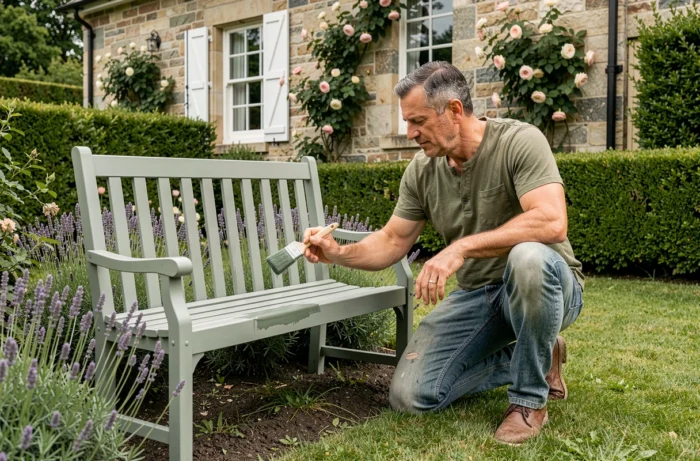
Between 2024 and 2026, the three most requested garden styles in France are the ecological garden, the contemporary garden, and the dry garden. The latter directly addresses the most common constraint among homeowners: limiting maintenance without sacrificing aesthetics.
The dry garden relies on drought-resistant plants (grasses, lavenders, agaves depending on the climate) combined with mineral mulch. It eliminates the chore of regular watering and reduces pruning to an annual intervention.
The contemporary garden, on the other hand, plays with geometric lines, raw materials (polished concrete, Corten steel, composite wood), and a limited plant palette. Its advantage: a neat appearance with a limited number of species to manage.
Both approaches share a common point that is often underestimated. They require a longer design phase than a traditional garden, but then generate much less ongoing work. The calculation is made over three to five years: the slightly higher initial cost is offset by the almost total absence of plant replacements and water consumption.
Terrace and Relaxation Area: The Masonry Bench Replaces the Garden Sofa
Garden furniture made of woven resin or aluminum remains the dominant reflex. However, a documented trend in 2025-2026 shows a decline in garden sofas in favor of masonry benches. The reason is practical before being aesthetic.
- A masonry bench does not need to be stored in winter, does not fade under UV light, and does not deform after a few seasons. Its lifespan far exceeds that of removable furniture.
- It integrates into the very structure of the terrace, freeing up floor space and giving the impression of a larger area, useful on small urban terraces.
- Comfort can be adjusted with interchangeable outdoor cushions, which are less expensive to replace than a complete lounge set.
This type of enhancement requires a load-bearing floor and, if the height exceeds a certain threshold, attention to local urban planning regulations. For an existing terrace in good condition, implementation remains accessible to a mason or a skilled DIYer.
Flowering Meadow and Lighting: Two Quick Levers to Beautify Home and Garden
The flowering meadow is the flagship trend of 2024-2025 for natural gardens. It advantageously replaces a classic lawn in low-footfall areas. A sowing in spring or autumn, on a simply scratched soil, is enough to achieve a flowering cover in a few weeks.
Its main advantage over a composite bed: no individual planting, no regular weeding, just one late mowing per year. The visual result is dense, colorful, and attracts pollinators, enhancing the ecological aspect of the garden.
On the home side, low voltage outdoor lighting transforms the perception of a facade or garden at dusk. A few recessed lights along a path, a string of lights on a pergola, or solar bollards in a bed are enough to create an atmosphere without heavy electrical intervention.
Current solar bollards offer sufficient autonomy for most summer evenings. For more powerful lighting (highlighting a tree, securing an access), a low voltage circuit connected to the panel remains preferable, with moderate installation costs if the wiring follows existing pathways.
Coherence Between Interior and Exterior: The Detail That Changes the Overall Perception
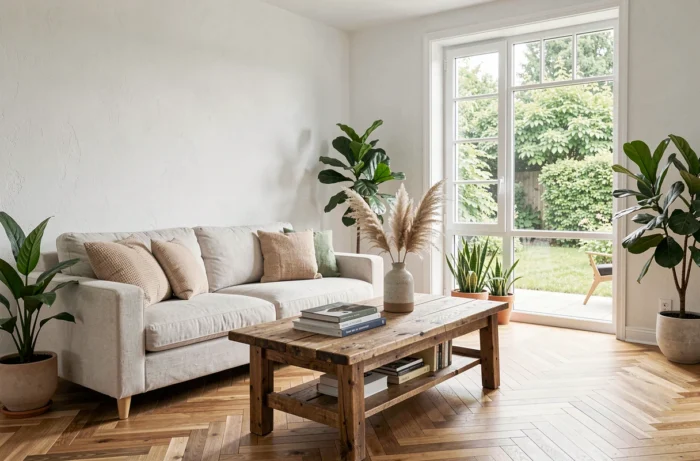
Beautifying your home without considering the transition to the garden often creates a visual gap. The most successful projects work on the continuity of materials between the interior floor and the terrace, or between the color of the woodwork and that of the outdoor furniture.
Two concrete points make a difference:
- Aligning the level of the sliding door threshold with that of the terrace eliminates the visual break and enlarges the space perceived from the inside.
- Using the same material (or a visually similar material) between the living room and the terrace creates a natural extension effect, even on a modest surface.
- The colors of outdoor containers (pots, planters) benefit from echoing a tone present in the adjacent room, rather than introducing a completely different palette.
This coherence does not require an additional budget. It is a matter of choosing shades and textures made in advance, at the time of selecting materials.
The areas with high visual impact and low maintenance (flowering meadow, lighting, masonry bench) share a common trait: they require more thought in advance than ongoing work. Concentrating the budget on the design phase, even at the cost of reducing the number of interventions, remains the most effective strategy for a lasting result.