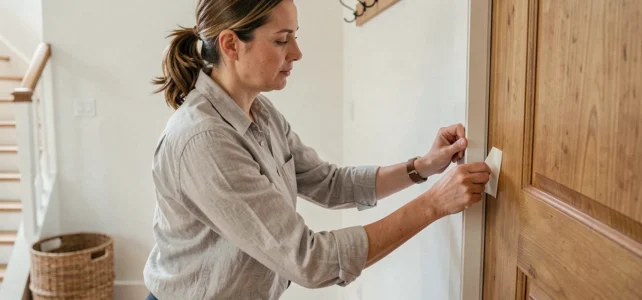
A cold wall to the touch in the middle of winter, a heating bill that rises without explanation, a south-facing room that has become unlivable in summer: these concrete situations reveal specific flaws in the envelope or equipment of a home. Improving the comfort and energy efficiency of your house relies less on a list of generic actions and more on a targeted diagnosis followed by coordinated work. Let’s take stock of the levers that truly make a difference.
Thermal bridges and air leaks: locating losses before renovating
Before ordering materials or signing a quote, it’s time-saving to precisely identify where the building is losing energy. A thermal engineer equipped with an infrared camera can spot thermal bridges (wall-floor junctions, window lintels, roller shutter boxes) and unwanted air infiltrations in just a few hours.
This step avoids a common pitfall: insulating an attic while most losses come from the walls. The energy performance diagnosis (DPE) provides an overall energy class but does not pinpoint defects. A complete energy audit, on the other hand, prioritizes areas of loss and proposes a coherent order of work.
On Reflexe Habitat, you can find useful resources to guide this type of approach and compare solutions suited to each housing configuration.
The classic trap is to treat insulation with isolated actions (a bit of blown wool here, double glazing there) without an overall vision. Field feedback shows that coordinated work packages yield gains two to three times greater than isolated interventions.
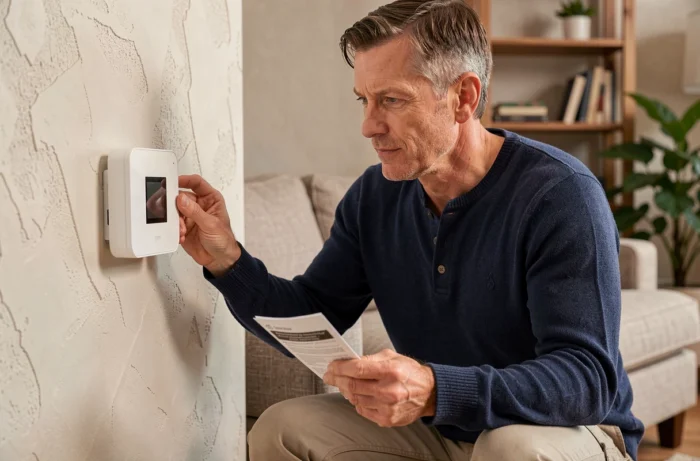
Heat pump and heating: where the real energy savings are concentrated
Among the works funded by MaPrimeRénov’ in 2024, heat pumps account for only about 23% of the files but concentrate 65% of energy savings and 53% of CO₂ emission reductions. The average energy gain associated with a heat pump reaches 14 MWh per year, compared to 4 to 4.8 MWh for insulation alone, depending on the type of wall.
These figures do not mean that insulation can be neglected. A heat pump installed in a thermal sieve operates in overdrive and wears out prematurely. The logical order remains: reduce needs (insulation, airtightness), then size the heating system accordingly.
Choosing between air-water and air-air
In renovation, the air-water heat pump adapts to existing radiator networks and also produces domestic hot water. The air-air version, less expensive to install, is suitable for homes without a hydraulic circuit but does not heat water.
- Air-water: compatible with high-temperature radiators, integrated hot water production, often higher COP in temperate climates.
- Air-air: quick installation via wall-mounted splits, possible cooling in summer, but no domestic hot water production.
- Geothermal (ground-water): stable performance year-round, ideal in cold climates, but drilling or horizontal capture work is required.
Feedback varies on this point depending on the region and exposure of the housing. Sizing by a thermal study office remains the best guarantee of real comfort.
Window insulation and ventilation: the often-overlooked duo
We spontaneously think of walls and attics, but single-glazed windows can account for up to a quarter of thermal losses in a house. Replacing them with double or triple glazing with enhanced insulation reduces perceived drafts and stabilizes the indoor temperature room by room.
The point that many homeowners discover afterward: a well-insulated and airtight house without suitable mechanical ventilation accumulates moisture. Condensation on windows, mold in corners, degraded air quality. Installing a double-flow mechanical ventilation system (VMC) after insulation work is not a luxury; it is a technical necessity.
Double-flow VMC: recovering heat from outgoing air
The double-flow VMC extracts stale air and preheats incoming fresh air thanks to a heat exchanger. In winter, it recovers a large part of the heat that would be lost with a single-flow VMC. In summer, the system limits the entry of hot outside air.
The extra cost of a double-flow VMC pays off in just a few winters in a properly insulated home. In a poorly insulated house, the gain remains marginal because unwanted air leaks short-circuit the exchanger.
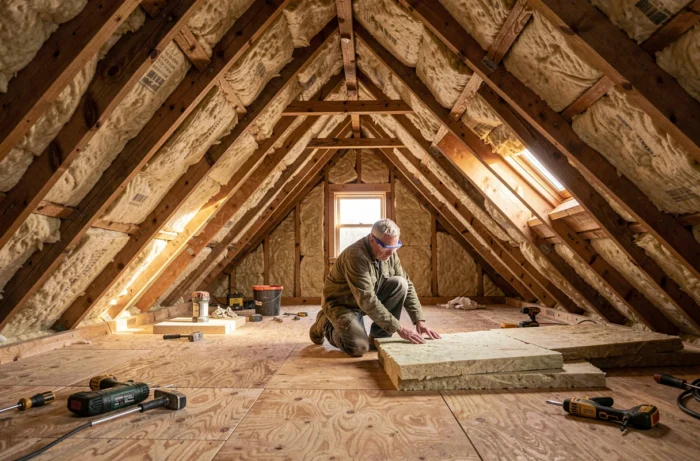
Major renovation and DPE schedule: anticipating regulatory constraints
In 2024, the number of homes benefiting from a major renovation funded by Anah increased by 28% year-on-year, reaching 91,900 homes. Among them, 79% reached the BBC Renovation first stage level, compared to only 23% the previous year.
This acceleration is not a coincidence. The schedule for the gradual prohibition of renting thermal sieves (classes G, F, then E) pushes landlords to act quickly. Waiting until the last moment exposes you to inflated quotes and extended intervention times, as qualified RGE artisans are already in high demand.
- Have an energy audit done now, even if renting is not yet prohibited for your DPE class.
- Prioritize works that achieve at least one class improvement: attic or wall insulation, replacement of the heating system.
- Check eligibility for MaPrimeRénov’ assisted pathway, which finances comprehensive renovations with a reduced out-of-pocket cost.
The new DPE planned for 2027 includes favorable adjustments for homes heated with electricity, which could remove several hundred thousand homes from the thermal sieve status. For a homeowner torn between two renovation scenarios, this evolution deserves to be factored into the calculation.
Improving the energy efficiency of a house fundamentally involves treating a complete system (envelope, heating, ventilation, regulation) rather than stacking disconnected actions. Renovated homes in packages achieve stable thermal comfort levels in both summer and winter, and their heritage value mechanically increases with evolving regulatory requirements.