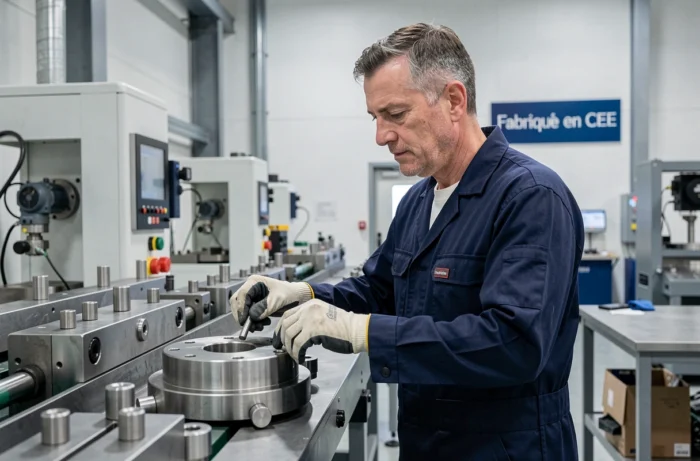
The “Made in EEC” or “Made in Europe” label is based on the non-preferential rules of origin set out in the Union Customs Code. The country of origin is determined by the last substantial transformation—not by the place of final assembly or the nationality of the commissioning party. This technical distinction shapes everything that follows: access to public procurement, commercial claims and regulatory compliance.
Non-preferential rules of origin and the limits of the Made in Europe label
The origin of a product labelled “Made in EU” is determined according to the last substantial transformation criterion. Goods whose components come from non-EU countries may legitimately carry this label if they undergo a sufficient production process within the European Union.
The problem is that consumers have no way of telling from the label whether almost all of a product’s added value comes from Europe or whether it was simply assembled in the EU from imported parts. The indication of origin remains binary: it provides no details about where the components come from or how the product was made.
Under proposals considered by the European Economic and Social Committee, products originating in countries linked to the EU by certain free trade or customs union agreements may even be treated as originating in the Union. The Committee notes that this broader scope raises questions about reciprocity and compliance with equivalent standards. This flexibility in the definition of “Made in EU” weakens the label’s value as a source of information for consumers.

Digital Product Passport: what the country-of-origin label doesn’t tell you
The European Ecodesign for Sustainable Products Regulation provides a framework for the Digital Product Passport. The specific requirements will depend on the delegated acts adopted for each product category, but the principle is established: make verifiable data on composition, supply chains and environmental footprint accessible.
To better understand the benefits of Made in EEC, it is important to understand how it differs structurally from a simple country-of-origin label. While “Made in Europe” provides only basic geographical information, a digital passport could document the origin of every component, manufacturing processes and associated carbon intensity. For professional buyers and informed consumers, the Digital Product Passport will make the country-of-origin label largely redundant.
We are seeing companies that anticipate this transition already investing in supply chain traceability—not out of virtue, but because future public tenders may require verifiable data on origin and carbon intensity.
European preference in public procurement: a legislative proposal, not an established right
On 4 March 2026, European Commissioner Stéphane Séjourné presented the proposed Industrial Accelerator Act, which would give preference to European companies in public procurement and public aid. The stated goal is to raise manufacturing’s share of EU GDP to 20% by 2035, up from 14.3% in 2024.
This remains a proposal under consideration. No general requirement to favour European suppliers currently applies across public procurement. Companies counting on this competitive advantage should understand that it is not an established right, but a legislative measure whose sectoral scope and eligibility conditions have yet to be defined.
The legal analysis of the proposal points to requirements for verifiable data on origin and carbon intensity in certain tenders. For the companies concerned, this would make component traceability an operational priority, not just a marketing argument. A simple “Made in Europe” declaration is unlikely to be enough to meet these criteria.
Practical benefits of Made in EEC for businesses and consumers
The real benefits of European labelling depend on the sector, product and target market. It would be inaccurate to reduce the label’s benefits to a simple quality mark: it serves as a commercial signal whose value varies by context.
For businesses, the operational benefits fall into three main areas:
- Simplified regulatory compliance: products manufactured in the EU comply by design with CE, REACH and RoHS standards, reducing import compliance costs and time to market.
- Potential access to public support schemes: if the Industrial Accelerator Act is adopted, companies able to document the European origin of their production could benefit from preferential terms in public tenders.
- Reduced logistics risks: shorter supply chains limit exposure to geopolitical disruptions and fluctuations in transport costs—a factor made tangible by recent crises such as Covid-19 and the war in Ukraine.
For consumers, a European-origin label indicates compliance with a regulatory framework covering safety, permitted substances and minimum working conditions, but it does not guarantee the product’s inherent quality. A “Made in Europe” textile meets REACH requirements for chemical substances, ruling out certain harmful treatments commonly used in other production regions.
European origin and environmental criteria: a proposed link
In its 2026 opinion, the European Economic and Social Committee advocates combining “Made in EU” criteria with low-carbon requirements for certain industrial products. This advisory position is not legally binding, but it points to the likely direction of future regulation.
The risk of circumventing origin requirements, which the Committee explicitly highlights, shows that labelling alone is not enough without a verification mechanism. Companies that make an origin claim without being able to substantiate it will face growing difficulties, whether or not regulations become stricter.

The “Made in EEC” label still has genuine commercial value, but its usefulness as a source of information has limits. We expect the Digital Product Passport, once rolled out category by category, to shift the debate from geographical origin to full value chain traceability. Companies that organise their production data now will be best positioned, whatever the final regulatory framework.