
A sliding platform for a pickup is based on a simple mechanical principle, but its longevity depends on details that most tutorials overlook: the choice of slide type, the calculation of the rear overhang, and compatibility with the vehicle’s residual payload. We will detail the critical design points before moving on to assembly.
Payload and rear overhang: what determines the design of the platform
Any device fixed at the end of the bed is entirely deducted from the payload and concentrates weight in the rear overhang, bringing the rear axle closer to its limit. A sliding platform made of marine plywood remains lightweight, but as soon as you switch to steel or thick aluminum, the weight of the drawer can represent a significant portion of the remaining capacity.
We recommend weighing the finished platform before assembly and subtracting this weight from the GVWR listed on the registration document, minus the actual empty weight. If the result leaves too little margin for your usual uses, you need to lighten the structure or reconsider the material.
Another often overlooked point: in France, any modification that alters the distribution of loads as defined by Article R.321-16 of the Highway Code may require a new approval of the vehicle by the DREAL or DRIEAT. The prior written agreement of the manufacturer is considered a necessary step, under penalty of refusal of approval and cancellation of the manufacturer’s warranty.
A comprehensive guide on the fabrication of a sliding platform for a pickup also details these regulatory constraints to anticipate before starting the cuts.
Rails and bearings for sliding pickup platforms: which system to choose
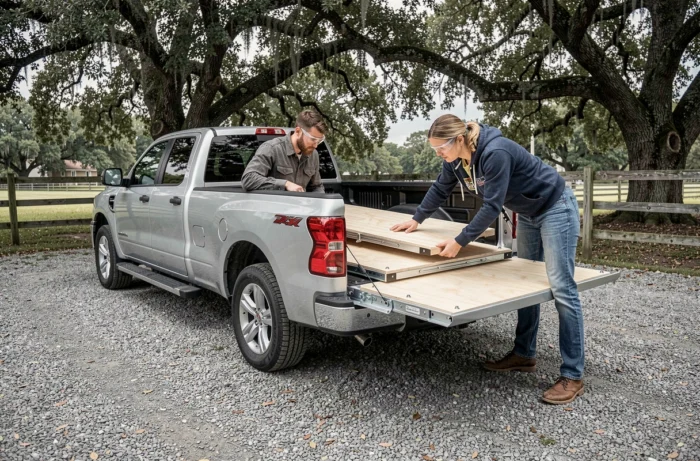
The sliding mechanism determines the smoothness, load capacity, and lifespan of the platform. Three options stand out.
- Telescopic ball rails (industrial drawer type): they offer full or partial extension of the bed and support high loads. Their lateral rigidity prevents the platform from deviating. We prefer them for intensive or professional use.
- Direct sliding on high-density polyethylene (HD 1000): a plate of HD 1000 placed on the bottom of the bed slides due to its low coefficient of friction. No wheels, no mechanical slides. The simplest solution, suitable for light everyday loads, but without locking in the extended position.
- Aluminum profile rails with nylon wheels: a compromise between cost and robustness. The wheels wear out faster than ball bearings, but replacement is quick and inexpensive.
For a standard pickup (bed of about 1.50 m of usable length), telescopic rails of 1.50 m with a load capacity suited to your needs are the most reliable choice. Measure the bed from the bottom to the closed tailgate before ordering.
Cutting and assembling the sliding platform step by step
Preparing the bottom panel
Cut the panel (marine plywood or aluminum depending on your choice) to the interior dimensions of the bed, removing a few millimeters from each side for operational play. A panel that is too tight will jam as soon as the wood swells or the bed slightly deforms under load.
If you are using plywood, apply two coats of marine varnish or epoxy resin on all faces, including edges. Moisture that stagnates in a pickup bed destroys an untreated panel in a few months.
Fixing the rails to the bed walls
Position the rails parallel to the sidewalls, at the same height. Use a laser level or a long bubble level to ensure horizontal alignment. A gap of a few millimeters between the two sides is enough to make sliding difficult under load.
Drill into the reinforcements of the bed, never into the thin sheet metal. Locate the ribs or doubled areas. Secure with through bolts and backing plates on the outside rather than with simple self-tapping screws, which can eventually pull out under road vibrations.
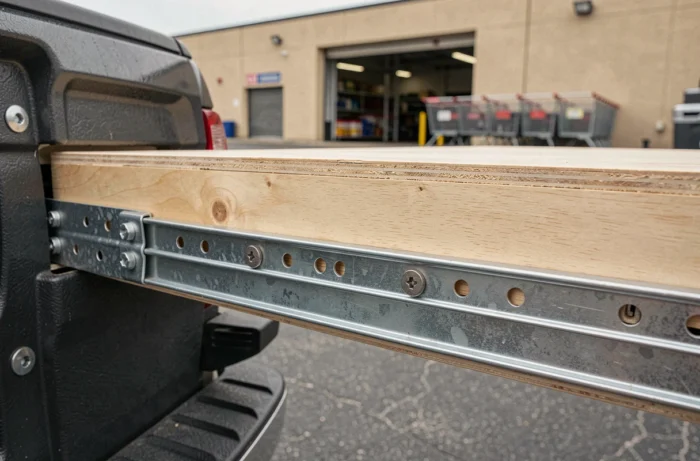
Assembling the platform on the rails
Screw the rails to the panel while respecting the manufacturer’s spacing. Test the sliding when empty before loading. The platform should extend and retract without any hard spots. If you feel resistance, check the parallelism of the rails.
Add end stops to prevent the platform from completely sliding out of its rails. Bolted blocks or retractable pins serve this function.
Straps and locking the drawer in the closed position
An unlocked sliding platform moves with every braking or turning. Two complementary systems address the issue.
Lever latches (like toolbox closures) fixed to the sidewalls lock the platform in the retracted position. Plan for at least two, one on each side, to distribute the load.
To secure the load on the platform itself, welded or bolted tie-down hooks at the edges of the panel allow for nylon straps to be tightened. Each strap should have a breaking strength significantly higher than the weight of the transported items.
Test the locking on the road before any actual transport: drive a few kilometers with the loaded platform, then inspect the fastenings. Vibrations immediately reveal weak points (loose bolts, misaligned rails, insufficient stops).
A well-constructed sliding platform transforms access to the bed, but its reliability depends on the care taken with the fastenings and the choice of rails. Take the time to check the parallelism, treat the wood, and lock the system before each trip. The first road test will tell you if the construction lives up to its promises.